formerly WalToR · WalT on the Roof

FeniXFlexible Edge Node for IoT Xperiments

FeniX is a modular hardware and software platform to rapidly prototype, deploy and instrument IoT experiments — in the lab as well as in real-world conditions.
LIG · Grenoble INP / UGA LabEx PERSYVAL Carnot LSI Open hardware & software
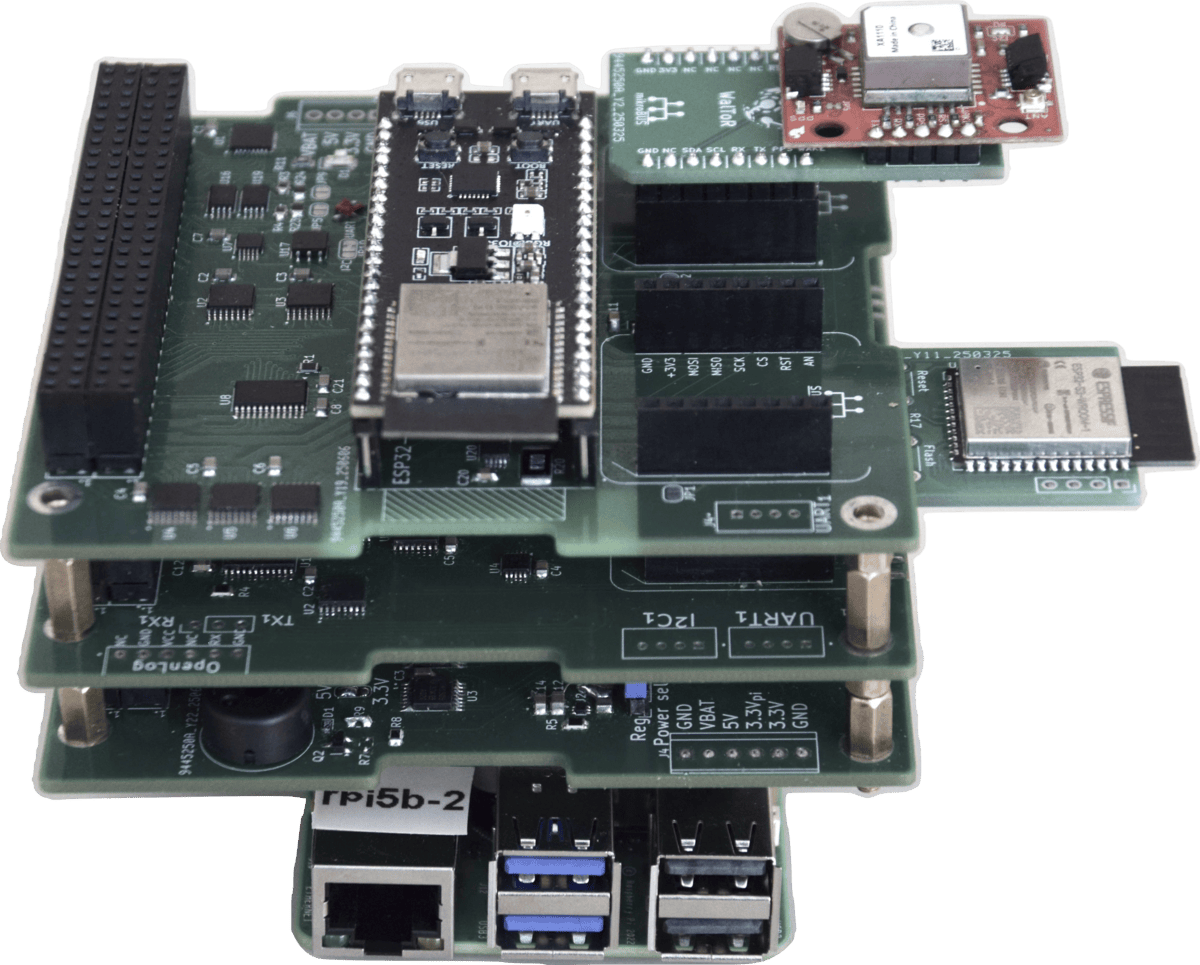
Architecture of a FeniX node

In a nutshell

An ultra-modular IoT experimentation node

What it is

A modular node — a Raspberry Pi controller + stackable daughter boards (extended PC104) + MCU modules (ESP32, STM32…) and mikroBUS slots — fit for an IP67 enclosure and fully remote-controllable.

What it is for

Rapidly prototype and deploy IoT experiments, and compare long-range technologies in real-world conditions — LoRa, NB-IoT, LTE-M, 5G, DECT NR+, Mioty, WiSun… — including their power profiles.

What sets it apart

Several MCUs and peripherals wired together dynamically and remotely, fine-grained synchronized energy instrumentation, and fully open hardware and software (KiCad, Linux).

The project

FeniX, the next step of WalT on the Roof

FeniX (Flexible Edge Node for IoT Xperiments) extends the project formerly named WalT on the Roof. The new name clarifies each role: FeniX is the modular hardware-and-software node, while WalT is the software platform that can drive it — without being a dependency.

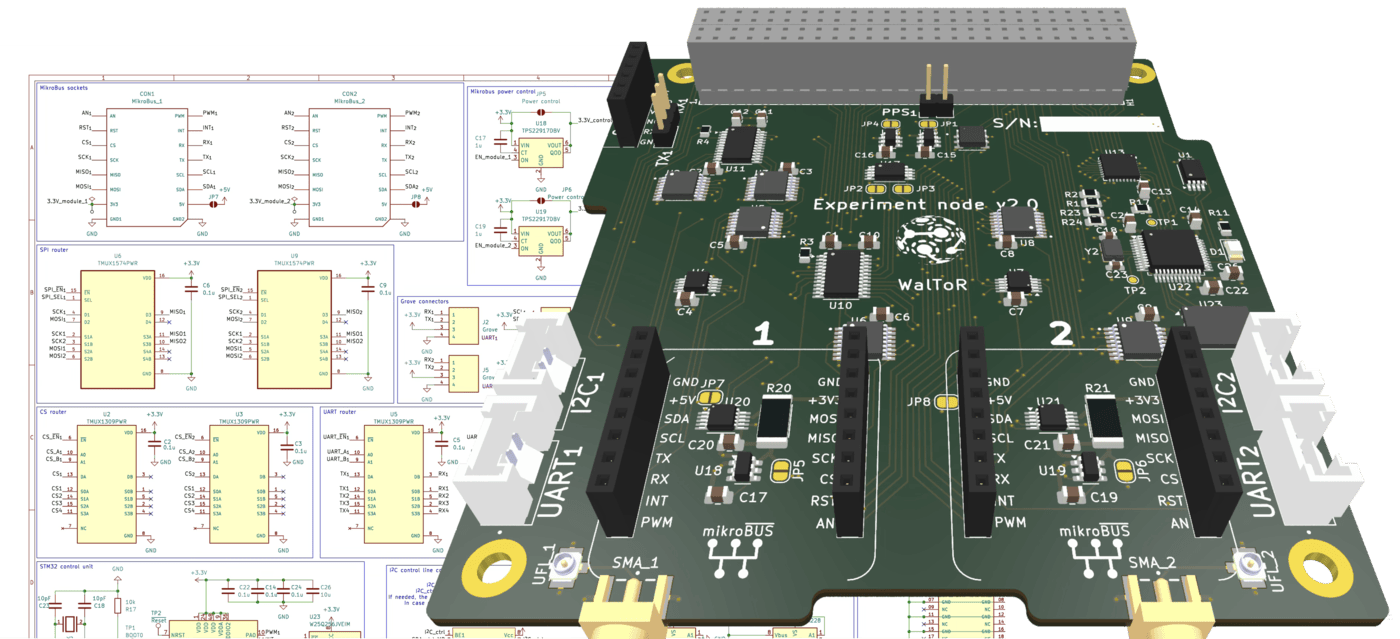
A node’s architecture is built on a stack of extended-PC104 daughter boards (compatible with the SEED pinout defined by CNES for ThingSat), driven by a Raspberry Pi control board. This modularity lets you add a feature on a single daughter board without redesigning the whole node, and combine custom boards with off-the-shelf modules through mikroBUS slots.

The project keeps maturing: hardware integration tests, a first experimental integration into FIT IoT-LAB, early experiments around Meshtastic and MeshCore, and a new energy instrumentation architecture under validation. FeniX was first funded as a platform by the PERSYVAL LabEx, then supported and renewed by the Carnot LSI institute.

Under the hood

Node architecture

A stack of extended-PC104 daughter boards, driven by a Raspberry Pi control board.

solar panel + battery ext. antennas IP67 enclosure · remote control via WalT (VPN) Control MCU power · battery · T° opening · Wake On LPWAN Raspberry Pi WalT integration backhaul Wi-Fi · NB-IoT · 5G Experiment MCU custom firmware · experiment control ↓ mikroBUS boards ↓ Interchangeable mikroBUS boards (radios, GNSS, clock…): LoRa / SatIoT NB-IoT / LTE-M 5G URLLC DECT NR+ Mioty / WiSun Wi-Fi HaLow 802.15.4 / Thread UWB Qorvo SDR GNSS RTK / TCXO Application appendices (sensors): air quality & fine particles · T°/RH/P · rainfall · noise pollution
Outline of a FeniX node: control, experimentation and mikroBUS peripherals in a deployable enclosure.
  • Control core: Raspberry Pi for configuration, control and monitoring, remotely operated.
  • Stackable daughter boards: extended PC104 format, compatible with the SEED pinout (CNES / ThingSat).
  • Experiment MCUs: several per node (ESP32, STM32…), firmware reconfigurable remotely.
  • mikroBUS: add/remove peripherals (radios, GNSS, clock…) with no hardware redesign.
  • Open hardware / software: KiCad design, WalT software integration, control over VPN.

Instrumentation

Fine-grained, synchronized energy measurement

An energy-instrumentation architecture (under validation) that correlates software events with power consumption.

µ

Multi-channel INA228 sensors

20-bit ADC: bus voltage, shunt voltage, temperature; current, power and energy computed on-chip. Conversion 50 µs → 4 ms.

High-throughput buffered acquisition

Fast Mode+ I²C reads, circular buffer in a dedicated STM32 (ns timestamps), UART-DMA upload. Useful rate up to ~700 kbps.

Synchronization & correlation

A shared PPS line across all channels and firmware GPIO monitoring to tie software events ↔ consumption directly.

Metrology: isolation & calibration

Power supply independent from the measured circuit, calibrated per channel — from an idle MCU to a radio TX burst.

Measured target MCU · peripheral Rsh shunt INA228 ADC 20 bits · I²C I²C STM32 buffer + ns timestamp UART RPi / WalT analysis · storage PPS — shared synchronization (1 Hz) firmware event GPIOs → software ↔ energy correlation
Measurement chain: from target to host, synchronized by PPS and correlated with GPIOs.

By the numbers

What stands out

10+
Radio technologies testable on the same node
µA → A
Current range profiled, from sleep to radio bursts
ns
Timestamp precision on energy samples
100%
Remote operation via WalT (VPN)
OSS / OSH
Open software and hardware (KiCad, Linux)

Ecosystem

Associated projects & teaching

Associated projects & platforms

Teaching units

📌 Course to be specified — [title / level / programme]

FeniX is meant to support lab sessions, student projects and internships. Associated teaching units will be specified soon.

Contact

A question, a collaboration idea, a deployment on your site?

Email the team · Franck.Rousseau@imag.fr